Home » Metabolic Testing
Most people who walk into The Adapt Lab have already had their labs done. The bloodwork came back normal. They were told everything looked fine. They still felt anything but.
That gap between “labs look fine” and “I don’t feel fine” is exactly what comprehensive metabolic health testing is built to close. The standard physical orders about a dozen markers. Most are designed to flag disease that has already crossed a clinical threshold. They were never designed to catch the slow, early shifts in metabolism, hormones, and inflammation that drive how you actually feel day to day.
Metabolic health testing at The Adapt Lab in Solana Beach is a different starting point. We measure the patterns first, then build everything else around what the data shows.
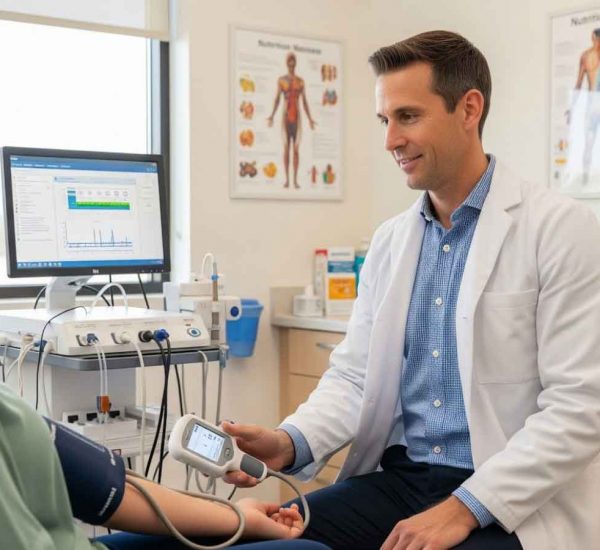

A typical primary care panel measures a handful of markers and compares them against population reference ranges. If your numbers fall inside those ranges, the visit ends with “looks normal.”
The problem is twofold:
That’s why patients with stubborn weight, fatigue, brain fog, sleep disruption, or unresolved hormonal symptoms can have entirely normal-looking labs and still be experiencing real, measurable metabolic dysfunction. The information is there. It just isn’t being measured.
Comprehensive metabolic testing at The Adapt Lab covers the panels that most patients have never had run together. Each marker is chosen for a specific clinical reason, not as part of a generic screening template.
HOMA-IR (Homeostatic Model Assessment for Insulin Resistance) is calculated from fasting glucose and fasting insulin. It tells us how hard your pancreas is working to keep your blood sugar stable. The higher the number, the more insulin resistance is present, and the more your body is set up to store fat instead of burn it.
This is the single most informative marker for understanding metabolic dysfunction in adults. It’s also one of the markers most often missed in standard care. A normal A1c with an elevated HOMA-IR is one of the most common patterns we see in patients who have been told their labs are fine.
Fasting glucose shows blood sugar in a resting state. A1c reflects average blood sugar over the past two to three months. Together, they show whether glucose regulation is currently a clinical concern. When read alongside HOMA-IR, they tell us where on the spectrum from healthy to insulin resistant to prediabetic to diabetic a patient actually sits.
A full thyroid panel includes TSH, free T3, free T4, reverse T3, and thyroid antibodies. Most primary care offices order TSH alone, which can miss meaningful patterns. Thyroid dysfunction is a common driver of fatigue, weight resistance, cold intolerance, and mood changes. Catching the full picture requires the full panel.
For both men and women, hormonal shifts are a major driver of weight resistance, fatigue, and recovery problems after age 35. Our hormone panels measure testosterone (total and free), estradiol, progesterone, DHEA-S, and cortisol patterns where indicated. The results inform whether bioidentical hormone balancing is part of the plan.
Standard cholesterol panels report total cholesterol, LDL, HDL, and triglycerides. That’s a starting point. Advanced lipid testing adds ApoB, sdLDL (small dense LDL), VLDL, and Lp(a), the markers more directly tied to cardiovascular risk than total LDL alone. Two patients with the same LDL can have very different cardiovascular profiles based on what’s underneath.
Chronic, low-grade inflammation is one of the most common drivers of metabolic dysfunction and a major contributor to weight resistance. hs-CRP (high-sensitivity C-reactive protein) is the primary marker we track. Elevated hs-CRP often correlates with elevated HOMA-IR and points to a metabolic environment that needs to be addressed before other interventions will produce results.
Targeted micronutrient testing measures vitamin and mineral status: B vitamins, vitamin D, magnesium, zinc, ferritin, and others depending on clinical context. Deficiencies in these markers can drive fatigue, mood changes, and metabolic slowdown that no amount of dietary effort will fix without correction.
When clinical patterns suggest food reactivity (digestive symptoms, post-meal fatigue, skin issues, unresolved inflammation), targeted food sensitivity testing is added. Body composition analysis is included when relevant to the treatment plan, particularly for patients pursuing medical weight loss where lean mass needs to be tracked alongside fat loss.
Testing at The Adapt Lab is not a standalone product. It’s the upstream input for every clinical decision that follows.
Based on the initial consultation, your symptoms, and your health history, we build a testing plan. Some patients need the full comprehensive panel. Others need a more targeted set of markers because prior labs already cover part of the picture. Either way, the testing is calibrated to your case, not a generic screening package.
Numbers on a lab report are only useful when read in clinical context. We sit down with you, walk through what each marker means for your situation, and explain how the markers interact. Patients often see patterns they’d never been shown before, things like an elevated HOMA-IR sitting next to high-normal A1c and elevated hs-CRP, all pointing to the same underlying issue.
Once the picture is clear, the treatment plan follows directly from it. The data dictates whether GLP-1 or dual-receptor peptide therapy makes clinical sense, whether hormone support is part of the plan, whether nutrition counseling needs to focus on insulin or inflammation, and whether targeted supplementation is required to correct deficiencies.
This is the entire reason testing matters. Without it, recommendations are guesses. With it, recommendations are clinical decisions grounded in your biology.


HOMA-IR, fasting insulin, full thyroid, advanced lipids, hs-CRP, and micronutrient testing are run as a coherent set, not as add-ons. Patients see the full picture in one visit instead of waiting through three referrals.
Lab values mean nothing without interpretation. Patients leave their results review knowing what each number means for their body, what’s connected to what, and what comes next.
Every other service at The Adapt Lab (medical weight loss, hormone balancing, nutrition counseling, IV nutritional therapy) draws on the data. Testing is not a one-time event. It’s the foundation the rest of the program is built on.
Lab values change as the body responds to treatment. Re-testing at structured intervals lets the clinical team adjust the plan based on what’s actually shifting, not what’s expected to shift.
Metabolic health testing at The Adapt Lab is appropriate for adults across a range of clinical situations:


The process runs over two to three visits at the start. The initial consultation reviews your history, current symptoms, and goals, and determines which panels we run. Lab work is drawn at our office or a partner draw site. Results typically return within one to two weeks, depending on the testing.
The follow-up visit is where the real work happens. Plan on a structured review of every relevant marker, the patterns connecting them, and the treatment plan that follows from the data. By the end of that visit, you’ll know exactly where your metabolism stands and what the path forward looks like.
Realistic expectations to hold:
Patients who consider themselves healthy often have at least one marker that surprises them. That’s the value of running the full panel.
No single lab value tells the full story. The clinical insight comes from how the markers connect.
Initial labs establish a baseline. Follow-up labs at three to six months show how the body is responding to the plan.
Every meaningful finding is paired with a specific next step.
If you’re tired of being told your labs look fine when your body says otherwise, the first step is a real workup. We’ll review what you’re experiencing, look at any prior labs you’d like to bring in, and outline which panels make sense for your situation.
The Adapt Lab is led by Dr. Chad Larson, NMD, DC, CCN, CSCS, and is located in Solana Beach, serving patients across North County San Diego.
Contact The Adapt Lab to schedule, or meet our clinical team before you book.